Oikos university shooting

Recommended Videos

Archroy

New member
Sep 30, 2010
47
0
0
farson135 said:
Archroy said:
That isn't true. Look further down and there is an option for a custom age range. Smack bang under the one you're using actually. Looks like you used just the right criteria to come up with an acceptable number of accidental child deaths caused by firearms, if there is such a thing.
Ok, age 0-16 deaths are 277 as opposed to my earlier 194. Not exactly a smoking gun.
They're still dead. Keep going up to the age of majority. The number gets bigger. When does it become a problem?

And as far as you saying that this survey is flawed : simply saying that it's flawed doesn't make it so. I don't agree with your objections to it. I don't care if the bloke/woman that did it was a biologist, a herpetologist or a trichologist.
I didn?t dismiss it because he is a biologist I dismissed it because he used techniques that are meant for studying biology and NOT criminology. I showed how exactly his methods were flawed. Will you address those instead?
If you're being honest, you dismissed this study because it doesn't support your position. And you dertainly brought up his 9whoever he may be) profession as a biologist as a problem.

"The person who handled that survey was not a criminologist or a sociologist but was instead a biologist. His methods were perfectly appropriate for studying bacterial cultures but NOT human behavior."

And if you look back at what I originally posted, I didn't link directly to a study, flawed or otherwise. I linked to a page that comes from the American Academy of P(a)ediatrics. I don't even know what the study that you have such a problem with is. I don't know who did it. I don't know when it was done. If there's a problem with it, whatever it is, show us a link to it and then provide a link showing a reasoned analysis of it. Like the one I did regarding the Kleck-Gertz study. If you read the link I posted about the K-G study, you'll see that it's nonsense on stilts. Wearing a Groucho Marx disguise. On a sparkly unicycle.

Unless you yourself are a criminologist/sociologist or whatever -ologist you deem fit to carry out research on gun safety.
Well, my main area of study is history with a minor in sociology (among other things).

The fact is that it wouldn't matter if the survey had been carried out by a resurrected, omnipotent, omniscient Charlton Heston. If it made guns look unsafe, you'd have a problem with it.
Would you mind backing the fuck off and telling me why exactly his not having time as a factor acceptable in this study? If you cannot then you are talking out of your ass.
No, I won't be backing the fuck off any time soon, barring bathroom breaks and sleeping. Care to explain why you think the following is a valid complaint about the elusive survey? Quote from you:

"Also (assuming they would not just use something else if guns were available), imagine all of the people on the main branch of your family since your Great-Grandparents. Got it? How many people is that? 30? 40? More? Now imagine that you take all of those people and just keep adding for a few more centuries. That is a lot of people. Now imagine that your family kept firearms in their home that entire time. Don't you think that eventually one of your family members will (at least) attempt to commit suicide, just based on odds?"

Where to begin? Very few people have their entire family living in the one house, unless they find themselves in really dire financial straits. Very few families occupy the same home for centuries, especially in America. From what I've seen, when buildings get old, they knock it down and start again. And regardless of all that, if you have a family member that is depressed and in a slough of despond decides that they want to end it all, if they use a gun, they're more likely to die than if they used another, less lethal method. It's a very specious argument.

On the subject of studies, you do realise that the Kleck study, which proves that there are a hundred gajillion DGU's per year has its detractors?

http://www.saf.org/LawReviews/Hemenway1.htm

Common DGU myths:

There are 1M to 2.5M DGUs annually in the US.

This has its genesis with criminologist Gary Kleck who has a number of studies as to the frequency of DGUs, ranging from 1M to 2.5M DGUs occurring annually in the US. If we assume Kleck?s methodology is flawless (it's not), there are problems with Kleck?s findings that are readily apparent. For example, Kleck?s own research states that in 8% of all DGUs, the gun is fired?wounding an alleged criminal. Kleck also notes that 15% of gun shot wounds are fatal. If we do the math: 2.5M DGUs x .08 woundings x .15 fatal wounds, we should have 30,000 justifiable gun homicides each year in the US. FBI UCARS routinely place the annual number of justifiable homicides at less than 300 per year--from all causes.
So? What am I Kleck?s keeper? I have never even held his studies as definitive. The only time I have ever mentioned Kleck?s study is when I say that there are between 108,000 and 2.5 million defensive gun uses per year. Those are the extremes so I put them at the extreme but I always say that the number is somewhere in the middle.

I still have no idea why you are getting so pissed off. I never mentioned Kleck (did you even know if I had heard of him before I told you I had) and my concern is with the statistics YOU provided. Defend them or just stop.
You and other pro-gun forum users have certainly cited the Kleck-Gertz "study" on these forums as evidence of the usefulness and necessity of firearms on a number of occasions. I bring it up as an illustration of the old proverb about those who live in glass houses. If you're going to claim that a study that is contrary to your position is flawed, you should probably think twice before citing another extremely flawed study that supports your position.

If you look at the mathematics of the K-G study and actually try to apply them to the real world, the whole thing collapses in an ignominious heap with its undercrackers round its ankles. Oh, and I'm not pissed off. And off to bed.

Prove it or shut up in 3...2...1...
 

TechNoFear

New member
Mar 22, 2009
446
0
0
farson135 said:
All suicide methods are lethal. It is only a question of forethought and willingness.
Suicide is the 2nd leading cause of death in people under 40 in the US (2005), 53% of suicides are by firearm.

US suicide rates are ~5 times higher than countries with comparable socio-economic conditions.

Most people who commit suicide do so because of some significant event.

24% of people who attempt suicide do so within 5 mins of this event, 70% within 60 mins.

If you survive a suicide attempt then you only have a 10% chance of actually committing suicide at a later date.

Point: If you have easy access to a firearm in those 5 / 60 mins you are more likely to succeed in that crucial first attempt.

http://www.nejm.org/doi/full/10.1056/NEJMp0805923

farson135 said:
They used this study-http://people.anu.edu.au/andrew.leigh/pdf/GunBuyback_Panel.pdf -to try and prove that less guns equals less homicide and suicide (look at the graphs on pg 42 to see what I am saying) when in fact both firearm AND non-firearm homicide/suicide were going down. Despite what the person who handled the study said that does not imply that things were improving due to the absence of firearms.
As we have dicussed a number of times, 6 scientific studies into the Australian 'gun buy back' show it reduced the number of suicides.

These studies did much more than 'look at the rates of homicides and suicides going down'.

You clearly have no concept of complex statistical analysis, as used by Leigh and Neill, have you?

The study did NOT use the raw statistics, instead using a complex equation to remove any trends already in the data.

Try actually reading section 4: Empirical Strategy and Results.

It has 16 pages that deal with your concerns about removing the current trends, as well as any deviation introduced by time shifts and data sampling methods.

Look at the equations used (ie page 23).

Dst = á + âÄGspost97t + Ssó + Ytô + ìst
Can you explain to me what that equation does?
If not how do you know that and the otehr equations failed to account for the current trends?
 

TechNoFear

New member
Mar 22, 2009
446
0
0
farson135 said:
TechNoFear said:
Suicide is the 2nd leading cause of death in people under 40 in the US (2005), 53% of suicides are by firearm.
No it isn?t- http://www.infoplease.com/ipa/A0005110.html
Not the data for UNDER 40 from 2005.

farson135 said:
Most people who commit suicide do so because of some significant event.

24% of people who attempt suicide do so within 5 mins of this event, 70% within 60 mins.
You misread the study. It said 5 minutes to an hour between the decision to kill themselves.
In Australia 60 mins is an hour. How many minutes is an hour in the US?

farson135 said:
Also that is questionable at best. Who the hell are they going to ask?
Reasons and timeframes can come from;
survivors accounts,
suicide notes,
last phone calls,
people who saw them alive before hand,
forensic evidence,
investigations at the scene,
etc

farson135 said:
And the study you showed ignored the fact that non-firearm suicide was also dropping at around the same time. That implies a socio-economic cultural shift.
Unless the study used some complex way of accounting for the amount of reduction for any 'socio-economic cultural shift'. see pages

Can't you understand that?

All the data is presented in the last few pages.

farson135 said:
You keep saying that this proves it but if it does then show it.
You linked the study and said it was wrong.

Why is the onus is not on you to prove your assertion that those scientists made a mistake?

farson135 said:
Overall suicide went down because both firearm and non-firearm suicide went down. Prove that that is irrelevant.
Section 4 proves it. Those 16 pages discuss how the decline in rates was shown to be irrelevent.
 

launchpadmcqwak

New member
Dec 6, 2011
449
0
0
farson135 said:
OP- Why are you asking NOW? It just happened. The full story will not be known for several weeks most likely.

Matthew94 said:
Why are these people so bad at killing people? They only ever get a few kills despite being in a building with hundreds of people.
Poor training combined with poor equipment.

Poor training, it takes a lot of skill and mental awareness to use a firearm properly. Some people think they can just dump rounds out there and people will die but it actually takes a lot of training. Plus with such poor training you do not know what you need to accomplish the mission.

Poor equipment, when Cho when on his attack he carried 2 pistols (one in each hand). There is a reason that modern soldiers do not carry two pistols into combat, because it is inaccurate. Cowboys did it because their guns were likely to misfire and it took time to pull the hammer back. Even so they still only fired one gun at a time and always brought the sight up. Combine with that the fact that he was firing indoors without hearing protection which hurt his inner ear which control balance.

The fact is that competent people tend not to go crazy. Trust me, if a good 3-gun shooter were to go crazy the body count would be high. The fact that they don?t is because of the base mindset of a criminal/insane person is considerably different from an expert in any field.

omega 616 said:
Guns are the problem, the next best option to a gun is a knife and to kill with a knife is a personal thing. You have to be up close but with a gun you can be hundreds of feet away, thus taking you out of the situation almost.
That is under the rather poor assumption that you can kill someone from 100 feet away. I have seen LEOs who cannot hit a target from 25 yards with their duty pistol.

Plus the basic fact is that guns are easy to build. Have a look at these- http://englishrussia.com/2007/06/04/chechen-self-made-weapons/

I have heard multiple times on those prison programmes that it is so much easier to kill with a gun.
So much so that they build guns INSIDE of prison.

It is actually easier to kill with other implements but guns are more mainstream and general purpose.

I await the day a pro gun person walks me through the exact situation where having a gun is good thing 'cos in every situation I see it being useless.
A friend of mine was driving along, another person hit his car, the guy got out with a tire iron, my friend pulled his gun and said back off, the guy left. You may not realize this but very few defensive gun uses end in someone getting shot. In fact there are between 108,000 and 2.5 million defensive gun uses EVERY YEAR.

Then you have the fact that I NEED guns to protect my property from wild animals.

Then you have another friend who lives on the Arizona/Mexico border. He has people running drugs across his property on a fairly regular basis. In fact his house has been broken into and shot at several times. He needs a gun to ensure that he does not get killed.

I can give you more if you wish.
you sir, are cool.
 

Archroy

New member
Sep 30, 2010
47
0
0
farson135 said:
Archroy said:
They're still dead. Keep going up to the age of majority. The number gets bigger. When does it become a problem?
How about when it become statistically relevant? You are talking about 0.13 per 100,000 people amongst just THAT population. Amongst the entire population it becomes even less relevant.

If you're being honest, you dismissed this study because it doesn't support your position.
Actually no. If you were being honest you would say that my statement conflicts with you and you do not like the fact that you cannot disprove what I say.

And you dertainly brought up his 9whoever he may be) profession as a biologist as a problem.

"The person who handled that survey was not a criminologist or a sociologist but was instead a biologist. His methods were perfectly appropriate for studying bacterial cultures but NOT human behavior."
Which means???..his methods were perfectly appropriate for studying bacterial cultures but NOT human behavior. I mentioned his profession as an explanation for why he used the wrong method. He used it because he is trained in a different field than what he is working in.

So what? Mr Kleck is a criminologist and he didn't seem to know what the fuck he was doing when he did his survey.
And if you look back at what I originally posted, I didn't link directly to a study, flawed or otherwise. I linked to a page that comes from the American Academy of P(a)ediatrics. I don't even know what the study that you have such a problem with is. I don't know who did it. I don't know when it was done.

In other words you posted some random numbers that you picked up from somewhere without bothering to check where they came from. You don?t know anything about those numbers yet you insult me as being bias? How do you know that the numbers were not just made up? Hell, why are you even defending those numbers after what I said? You have yet to show how his not using time does not affect the validity of the study. You call me biased yet this is the bullshit you come up with. Address my actual point.
No, I posted a link to a website by the AAP. I have no reason to think that they would lie about the best way to protect your children at home. Paediatricians tend to be pro child welfare on the whole. And now, having read the study that you have such a problem with, we see that it deals with "Gun Ownership as a Risk Factor for Homicide in the Home". So even if I were to accept that it is so badly flawed (which based on your objections, I don't), it only addresses the matter of murders. It ignores gun suicide and gun accidents, much like you do.

If there's a problem with it, whatever it is, show us a link to it and then provide a link showing a reasoned analysis of it.
Here it is.
http://www.nejm.org/doi/full/10.1056/NEJM199310073291506

There are lots and lots and lots of analysis that show the flaws. Here are a few-
http://www.keepandbeararms.com/information/XcIBViewItem.asp?ID=2331
http://www.saf.org/LawReviews/PolsbyFirearmCosts.htm
http://www.jpands.org/hacienda/edcor6.html
http://www.constitution.org/2ll/2ndschol/58tenn.pdf
http://www.thetruthaboutguns.com/2011/01/william-c-montgomery/editorial-deconstructing-kellermann/

Like the one I did regarding the Kleck-Gertz study. If you read the link I posted about the K-G study, you'll see that it's nonsense on stilts. Wearing a Groucho Marx disguise. On a sparkly unicycle.
I looked through those and surprise, surprise, all of them but one uses Kleck's exercise in wishful thinking to "refute" the Kellerman study. Sorry, but no dice.

Why exactly did you link wrongly? Was an accident or were you trying to prove something about me? Given the fact that I have heard of the study (and in fact have read it) I felt no need to follow the link.
You've lost me there with the link wrongly comment. This link:

http://www.saf.org/LawReviews/Hemenway1.htm

has a detailed analysis of the Kleck study and why it is massively flawed. Unless you refer to the part just underneath it headed "common DGU myths". That bit is from a different website. I was pretty pissed up and tired when I typed the post. I even put a 9 instead of a ( in one place. Stupid shift key.

No, I won't be backing the fuck off any time soon, barring bathroom breaks and sleeping. Care to explain why you think the following is a valid complaint about the elusive survey? Quote from you:

"Also (assuming they would not just use something else if guns were available), imagine all of the people on the main branch of your family since your Great-Grandparents. Got it? How many people is that? 30? 40? More? Now imagine that you take all of those people and just keep adding for a few more centuries. That is a lot of people. Now imagine that your family kept firearms in their home that entire time. Don't you think that eventually one of your family members will (at least) attempt to commit suicide, just based on odds?"

Where to begin? Very few people have their entire family living in the one house, unless they find themselves in really dire financial straits. Very few families occupy the same home for centuries, especially in America. From what I've seen, when buildings get old, they knock it down and start again.
Wow, you missed the point entirely. My statement was not meant to be taken like that. Just through odds your family is likely to have someone (at least try to) commit suicide eventually. If your family had a gun in the home from an early age you are likely to have a gun in your home. Eventually both likelihoods are going to collide (especially considering the prime age for suicide is the time when you may still be living with your parents).
So what you're saying is that the presence of a gun in a house where a suicidal individual can get to it means that they'll use the gun? If you read on, Macduff, you'll see why that is a bad thing. Also it has no bearing on the study you dislike so much, because suicide is not murder.

And regardless of all that, if you have a family member that is depressed and in a slough of despond decides that they want to end it all, if they use a gun, they're more likely to die than if they used another, less lethal method. It's a very specious argument.
All suicide methods are lethal. It is only a question of forethought and willingness.
No they aren't. Different suicide methods have varying degrees of lethality.

http://www.crisis.org.cn/uploadfile/readparty/methods--lethality.pdf

Take a look at the link above. It clearly shows that firearms are the most lethal method.

http://jech.bmj.com/content/57/2/120.abstract

Next one. The results show that:

"Firearms are the most lethal suicide method. Episodes involving firearms are 2.6 times (95% CI 2.1 to 3.1) more lethal than those involving suffocation?the second most lethal suicide method. Preventing access to firearms can reduce the proportion of fatal firearms related suicides by 32% among minors, and 6.5% among adults. "

http://lostallhope.com/suicide-methods/statistics-most-lethal-methods

Take a look at the table at the above link. Of the top 4 most lethal methods 1,3 and 4 involve firearms. Number 2 is cyanide.

http://www.hsph.harvard.edu/means-matter/means-matter/case-fatality/index.html

Firearms most lethal.

Clearly, access to a firearm means that if you decide to off yourself and you use it, you're more likely to die. Unless you think that anyone using another method isn't trying hard enough and needs to buck their ideas up. Find a higher building perhaps, or jump in front of a bigger bus. There's never one around when you need one and then three come along.


I'll say it again:

http://www.healthychildren.org/English/health-issues/conditions/emotional-problems/Pages/Teen-Suicide-and-Guns.aspx

"Studies have shown that the risk of suicide is 4 to 10 times higher in homes with guns than in those without."
" Suicide attempts with a gun are very likely to be deadly."
"Suicide attempts with drugs or methods other than guns have a greater chance of survival."
"Most young survivors of a serious suicide attempt do not commit suicide later, and most survivors of suicide attempts are glad they were saved."

I hope that we can at least agree on the fact that the fewer people who kill themselves the better, particularly the very young.
I bring it up as an illustration of the old proverb about those who live in glass houses. If you're going to claim that a study that is contrary to your position is flawed, you should probably think twice before citing another extremely flawed study that supports your position.
Your study is flawed. That is without a doubt. The Kleck study is flawed and I (and many others) have said as much. In fact I said it in my LAST POST (which you apparently ignored for the sake of your own bias).

No doubt it is flawed to a degree. All studies are to some extent. Kleck's is really flawed. And once again, Kellerman only deals with homicide. Not accidents or suicides.
Oh, and I'm not pissed off.
Then how about you disprove my actual point and stop with the ad hominem? Or is that beyond you.
What is your point exactly? That access to a firearm doesn't make a suicide attempt more likely to succeed? Demonstrably false. That firearms in the house don't make it more likely that you'll be murdered? I don't agree. Quibble with that study all you like. To borrow your analogy about suicide and the family gun:

"Imagine all of the people on the main branch of your family since your Great-Grandparents. Got it? How many people is that? 30? 40? More? Now imagine that you take all of those people and just keep adding for a few more centuries. That is a lot of people. Now imagine that your family kept firearms in their home that entire time. Don't you think that eventually one of your family members will (at least) lose their temper with another family member, grab the gun, point it and pull the trigger and then spend the rest of their life wishing they hadn't, because you can't take a bullet back.

My bold.

According to the FBI:

"In 2009, 24.2 percent of victims were slain by family members; 53.8 percent were killed by someone they knew (acquaintance, neighbor, friend, boyfriend, etc.). The relationship of murder victims and offenders was unknown in 43.9 percent of murder and nonnegligent manslaughter incidents in 2009."


As we all know, you're more likely to be killed by someone you know than by a stranger.
 

senordesol

New member
Oct 12, 2009
1,301
0
0
I really wonder why the suicide stats are brought up in relations to 'should civilians own firearms?'. Am I really expected to believe that having a hunk of machinery lying around is going to make me more likely to kill myself? All parts being equal, if I am content and satisfied with my life, how does owning a firearm change that to the point I want to take it?

I'll grant that if I were inclined to take my life, a firearm increases my chances of being successful; but all that suggests is that you probably should have a firearm if you're suicidally depressed, not just in general.
 

Archroy

New member
Sep 30, 2010
47
0
0
farson135 said:
Archroy said:
Ok, first you really need to learn how to post without jumbling everything up. Look at my posts in relation to yours. I am having a hell of a time just picking out what you are trying to say.
Yup. Still trying to get my head around it.

Klecks methods were flawed but Kellermanns study was just as flawed.
So you say.


The government is well known for using faulty surveys to make policy decisions.
Citation needed, as they say.


Guess what, you need to look through those goddamn papers and pay fucking attention. You may not like what they say but the study you used is flawed. That is simple fact. Unless you can prove otherwise. Those studies made valid points and you are refusing to read them.
Rawr! Guess what?. I never used a study. I linked to a webpage by the AAP, sinister government department of doom.


Here is the name of the other study (the one I was specifically referencing). Feel free to look it up.
Arthur Kellermann, "Protection or peril? An analysis of firearms related deaths in the home."

It is referenced here-http://en.wikipedia.org/wiki/Arthur_Kellermann#1986
It says:
For every case of self-protection homicide involving a firearm kept in the home, there were 1.3 accidental deaths, 4.6 criminal homicides, and 37 suicides involving firearms. Handguns were used in 70.5 percent of these deaths.


Negative. Asphyxiation, crush damage, etc are just as lethal, they just are not used as effectively.
Ha haa. That's a doozy. It's akin to saying death is fatal 100% of the time. I guess your position on the lethality of different suicide methods boils down to "LOL, lrn2suicide n00b!"
Different suicide methods have different rates of "success", if we can term it that. Get over the fact that a shotgun to the face is more deadly than cutting your wrists, taking pills, gassing yourself or any other method.


Guns are highly successful in the US because people use them a lot. Lithuania manages to have the world highest suicide rate despite having only 0.7 guns per 100 people (for reference the UK has 6.8 guns per 100 people).
http://www.ncbi.nlm.nih.gov/pubmed/15456979

Yeah, they hang themselves mainly. Second most common method for males is firearm. So what? Lithuania and the USA are hardly comparable countries. Imagine how high US rates might be if it had a similar history.

The fact is that if a person really wants to commit suicide they will.
No. They will try. They won't necessarily succeed. Their success or failure will depend partly on the method they use.

My Great-Grandfather was in his 90s, he couldn?t walk anymore and was confined to a bed, he couldn?t eat anymore and had to be fed through a tube, he was in pain and miserable. The doctors wanted to keep him at the hospital where they said they could prolong his life by a few months or years. He signed a do not resuscitate and told them to send him home. He effectively committed suicide and despite my sadness I supported him. Reon said that I did not care about human life because of that. Are you like him or do you support the idea that if a person?s life no longer holds any meaning to them then forcing them to live is wrong?
Nope. If your life has become intolerable, I think you should be able to end it painlessly. That is however not the crux of this matter. There are relatively few young people, especially children who find themselves in this position. The majority of suicides are not the same as your Grandfather's decision.


That access to a firearm doesn't make a suicide attempt more likely to succeed? Demonstrably false.
The Lithuanians manage it. So do the Japanese and others.
So what? Who knows how much higher their rates might be if they had ready access to firearms?


The state of Idaho has a gun ownership rate of 64 per 100 people. Their murder rate is 1.3 per 100,000. The UK has a gun ownership rate of 6.8 per 100 people and their murder rate is 1.2 per 100,000. Ten times the gun ownership rate and a statistically similar murder rate.
So you've picked the best example for your position. What about the 49 others?


http://www.ncbi.nlm.nih.gov/pmc/articles/PMC1447364/


The above study's findings include:

In the six states with the highest rates of gun ownership, an average of 53% of households owned firearms; in the four states with the lowest rates of gun ownership, an average of 13% of households contained firearms.
From 1988 to 1997, the high-gun states had more than 21,000 individuals who were homicide victims, compared with 7,300 in the low-gun states
People living in the high-gun states were 4.2 times more likely to die in a gun-related homicide than those in the low-gun states, and 1.6 times more likely to die in a non-gun-related homicide
After controlling for rates of poverty, urbanization, unemployment, per capita alcohol consumption, and violent crimes other than homicide, the association between rates of firearm ownership and homicide remained significant.


"Imagine all of the people on the main branch of your family since your Great-Grandparents. Got it? How many people is that? 30? 40? More? Now imagine that you take all of those people and just keep adding for a few more centuries. That is a lot of people. Now imagine that your family kept firearms in their home that entire time. Don't you think that eventually one of your family members will (at least) lose their temper with another family member, grab the gun, point it and pull the trigger and then spend the rest of their life wishing they hadn't, because you can't take a bullet back.
Nope.
So it's never happened then? That's a relief. Oh, wait.

http://abcnews.go.com/US/story?id=91821&page=1#.T38eEPVURTY
http://usnews.msnbc.msn.com/_news/2011/12/27/9744433-santa-claus-killings-financially-strapped-dad-planned-family-massacre-texas-police-say
 

Dragonclaw

New member
Dec 24, 2007
448
0
0
This was crazy! I live in Alameda AND I was grocery shopping at that Safeway when they arrested the guy
 

TechNoFear

New member
Mar 22, 2009
446
0
0
farson135 said:
I wonder if you realize what you are saying. You are saying, these guys used numbers to take actual statistics and change them so that an entire set of (inconvenient) statistics are negated.
I am saying it is possible to remove other influences using complex statistical analysis, such as 'instrumental variables'.

Just because you do not understand the methodology does not make it wrong.

Specifically the study used a variety of methods, of interst is the use of differences-in-differences on a predictive model using panel techniques.

This relies on variations in intensity of legislative change across the states. This is better than using a simple time series approach, as it accounts for time specific shocks.

Put in a way you might understand; if you look at the rates in different Australian states where the gun buy back happened faster and more firearms were removed, you see proportional faster drops in homicide and suicicde rates (than happened in the 'slower' states).

This method accounts for the ongoing socio-economic trends because it cross refences data from demographics all under going the same socio-econimic changes.

Put in a way you might understand; So states that removed more firearms faster had larger drops in the suicide and homicide rates (and the socio-economics remained the same for all states during this period).

farson135 said:
I did. I showed my evidence that they did not factor in non-firearm suicide. Now you have to prove me wrong.
Your the 'rates were already dropping' is not a valid argument.

Are you so uneducated that can not comprehend the mathematics used?

Or so unethical you are ignoring anything that disagrees with your opinion?

Lets go with the former; You are saying raw data can be used to show trends? That no statistical analysis is required?

OK.


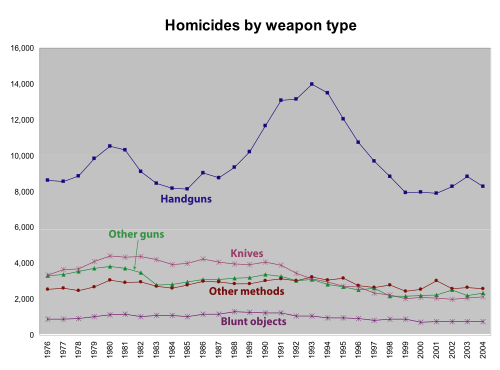
Brady was enacted in 1993 and the VCC&LE act (inc Assault Weapon Ban) in 1994.

Look at the big drop in homicides exactly when stricter firearm contols were enacted.

So you can't have it both ways farson.

Either raw data is acceptable and that graph proves stricter firearm controls reduced homicides in the US.

OR

You can say that 'correleation does not imply causation', which will negate your argument agaist the study by Leigh and Niell (and the other 6 studies that show the same drop in homicides and suicides in Australia).

Which is it?
 

Archroy

New member
Sep 30, 2010
47
0
0
farson135 said:
Some snippage also.


It's akin to saying death is fatal 100% of the time.

Yes. Unfortunately y'all keep shooting past the obvious. Things that are deadly are deadly for a reason. If that reason is used to kill oneself then it is all equally deadly.
What does this even mean? I'm really struggling to understand the bit that I bolded, because it makes about as much sense as "And ye mome raths outgrabe."

I have shown, with statistics, that suicide attempts involving a firearm result in more fatalities than other methods. People tend not to keep trying over and over until they get it "right" and I believe that this is a good thing. You seem to think that they should man the fuck up and do the job properly, the pussies.

Different suicide methods have different rates of "success", if we can term it that.

Wait, what? Is that progress? Boffo.

Get over the fact that a shotgun to the face is more deadly than cutting your wrists, taking pills, gassing yourself or any other method.


Not by necessity. Bleeding out and the subsequent brain death is just as deadly as brain death through high speed lead. In fact bleeding out is a better guarantee because shot does weird things when it hits bone.
*Sighs* So now you're an expert on bleeding to death. Ok, should have known. I'm ducking out of this after this post. Not because you've "won", or because I've changed my mind. The whole thing is getting beyond silly now and I don't think you even know what your position on suicide is. You just agreed that different methods have different "success" rates and then you didn't agree.

This quote seems appropriate:

"Alice laughed: "There's no use trying," she said; "one can't believe impossible things."
"I daresay you haven't had much practice," said the Queen. "When I was younger, I always did it for half an hour a day. Why, sometimes I've believed as many as six impossible things before breakfast."
Alice in Wonderland.


If you look here:

http://www.teensuicidestatistics.com/statistics-facts.html

we can see the differences in suicide amongst young people by gender.

"Teen suicide statistics show differences in the ways boys and girls handle suicide. While girls think about attempted suicide about twice as much as boys, boys are actually four times more likely than girls to actually die by killing themselves.

The disparity in the number of "successful" suicide attempts between boys and girls is probably explained by the methods that each use when attempting to kill themselves.

Girls who attempt suicide are more likely to try killing themselves by overdosing on pills or by cutting themselves. Cutting is a behavior that is more common among girls. Additionally, overdosing on pills is a less violent way to commit suicide. Some girls even choose pills because it allows them time to "stage" their appearance before. Some girls find it more "romantic" to die in such a way.

Boys are more likely to choose a method of attempted suicide that is more lethal - and quick. Boys more often use guns (60 percent of all suicides in the United States make use of a gun), jump from great heights or hang themselves. This is why they are more likely to die in a suicide attempt. By the time someone discovers a problem, it is usually too late to prevent death. "

The difference is down to the method.

Just so that I know, please answer the following question.

Given that person a decides to kill themselves and proceeds to make a single attempt on their life, do you think that they are more likely to succeed if they put a shotgun in their mouth and pull the trigger, or if they cut their own throat?


Yeah, they hang themselves mainly. Second most common method for males is firearm. So what? Lithuania and the USA are hardly comparable countries. Imagine how high US rates might be if it had a similar history.
So what? You are telling me that the presence of firearms causes more successful suicides but in Lithuania, where they have almost no guns, the suicide rate is one of the highest in the world (the highest in many years).
No, I'm saying that if Lithuanians had ready access to firearms, the rate may well be higher because there would be more successful attempts. Similarly, if the USA had a similar history to Lithuania, the suicide rate may be higher. If you look at the link that you posted:

http://www.who.int/mental_health/prevention/suicide_rates/en/

Assuming that it is accurate, which I have no reason to doubt, we can see that quite a few of the former Soviet states have pretty high rates of suicide. I assume that this is because of social issues that are at least partly caused by their complicated political history, what with them having been repressive dictatorships and all that. Quite unlike the USA.

So what? Who knows how much higher their rates might be if they had ready access to firearms?
They manage to kill themselves fine without firearms. You try and say that their suicide rates would be higher but do you have any proof?
No, I don't. I postulated a hypothesis based on the information I've recently been reading. Given that suicide by firearm is by far the most lethal method, it didn't seem to unreasonable to think that if they had ready access to guns, there would be more successful attempts. At least in the Bizarro universe I must inhabit.


Nope. If your life has become intolerable, I think you should be able to end it painlessly. That is however not the crux of this matter.
Actually it is. At what point does it become immoral to force a person to continue living? After they try to commit suicide two, three, four, five, or more times? There was a person at a neighboring high school that was like that. They had him committed and forced him to stay alive in misery despite the fact that he wanted to die. At what does it stop being moral to preserve live and instead become amoral?
I assume you mean immoral, but I dunno. I'm not an ethicist. Some people do need to be hospitalised for their own protection. One of my distant cousins was a paranoid schizophrenic who had to be locked up for his own safety a number of times. I would hope that we at least agree that in the vast majority of cases, it would be preferable to support and help a depressed young (or old) person than to say "Fuck it, we've spent long enough on that one. Bin him bring in the next subject." The example you use is an extreme case. As we know, the plural of anecdote isn't evidence. It's anecdotes.

Look, I am not saying that the presence of guns equals less murder but I am stating that socioeconomic-cultural conditions have always and will always trump the presence of an object.
I don't disagree with you. They do make it easier to kill someone though. And I know your natural instinct is to say, "Bullshit, they'd just use a knife, hammer or a rubber chicken with a pulley." I don't accept that. If it was the case, you wouldn't have so many gun murders.Pointing a gun, pulling the trigger and watching the target fall isn't the same psychologically as bludgeoning somebody repeatedly with a blunt object until their skull caves in or stabbing them multiple times and getting covered in their blood. And yes, I know you have a bad-ass Ka-bar that would cleave someone in twain with one mighty slash. The problem is that it might get stuck in a rib and then where would you be? Talk about embarrassing.
 

ElPatron

New member
Jul 18, 2011
2,130
0
0
Archroy said:
I don't disagree with you. They do make it easier to kill someone though. And I know your natural instinct is to say, "Bullshit, they'd just use a knife, hammer or a rubber chicken with a pulley." I don't accept that. If it was the case, you wouldn't have so many gun murders.Pointing a gun, pulling the trigger and watching the target fall isn't the same psychologically as bludgeoning somebody repeatedly with a blunt object until their skull caves in or stabbing them multiple times and getting covered in their blood.
Have you ever pointed a gun at someone? You don't know how it is until you have, please don't try to pretend you know how it's like. So, if you NEVER pointed a loaded gun at someone don't tell us how it feels.

Do they make killing easier? I don't know. Aiming a handgun isn't exactly training free, and we all know handguns are poor man-stoppers. Do you prefer a small hole or a botched cut from a inexperienced dude? Botched cuts are awful and harder to patch up.

Actually, it's pretty easy to stab people several times. Knifes are not defensive weapons, they can only be used for offense. So during knife fighting, most people will try repeated stabs. You'd be full of holes before the attacker realizes they just committed murder.

And let's not forget how many murders occur with blunt force trauma on a single hit. People underestimate the fact that any object is a deadly weapon in the right conditions. Most times it only takes a spurt of rage and someone is dead. No need for repeated bashing.

Anyway, this is the Escapist... I have seen people saying "You shouldn't use guns for self-defense, it's too violent! You should bash them with a baseball bat!"

Archroy said:
And yes, I know you have a bad-ass Ka-bar that would cleave someone in twain with one mighty slash. The problem is that it might get stuck in a rib and then where would you be?
I think it was one of the guys who designed the SAS knife that found that stabbing someone between the ribs decreases pressure in the lungs.
 

Archroy

New member
Sep 30, 2010
47
0
0
ElPatron said:
Have you ever pointed a gun at someone? You don't know how it is until you have, please don't try to pretend you know how it's like. So, if you NEVER pointed a loaded gun at someone don't tell us how it feels.
Of course not. That would be a very silly and dangerous thing to do.

Do they make killing easier? I don't know. Aiming a handgun isn't exactly training free, and we all know handguns are poor man-stoppers. Do you prefer a small hole or a botched cut from a inexperienced dude? Botched cuts are awful and harder to patch up.
The one time I shot a pistol, I found aiming it to be a complete piece of piss to be honest. Same with the rifles. And regarding the "small hole" caused by a bullet; you do realise that it doesn't just vanish after piercing the skin? They often keep moving quite a bit and can cause quite a bit of damage. Have a look at this link for more info.

http://health.howstuffworks.com/human-body/parts/best-place-to-get-shot1.htm

A couple of quotes.

"As a bullet enters the body, it causes laceration and crushing wounds. The bullet punctures tissue and bone, crushing or pushing aside anything in its path. When a bullet passes through tissue, it creates a cavity that can be 30 times wider than its track (the path it takes). This cavity closes behind the bullet less than a second after the bullet passes, but the cavitation it causes can damage nearby tissue, organs and bones via shock waves."

" Jacketed bullets are designed to fragment after impact, dividing their destructive power. Hollow-point and soft bullets are designed to flatten and spread, creating a wider area for their tracks and increasing the damage caused by shock waves and cavitation."

Actually, it's pretty easy to stab people several times. Knifes are not defensive weapons, they can only be used for offense. So during knife fighting, most people will try repeated stabs. You'd be full of holes before the attacker realizes they just committed murder.
Please do me the kindness of allowing me to paraphrase a bit of your text here.

Have you ever stabbed someone full of holes? You don't know how it is until you have, please don't try to pretend you know how it's like. So, if you NEVER someone full of holes, don't tell us how it feels.

And let's not forget how many murders occur with blunt force trauma on a single hit. People underestimate the fact that any object is a deadly weapon in the right conditions. Most times it only takes a spurt of rage and someone is dead. No need for repeated bashing.
Have you ever killed someone with a single blow from a blunt object?? You don't know how it is until you have, please don't try to pretend you know how it's like. So, if you NEVER killed someone with a single blow from a blunt object, don't tell us how it feels.

Out of interest, how many murders occur with blunt force trauma on a single hit? I'd love to know.


I think it was one of the guys who designed the SAS knife that found that stabbing someone between the ribs decreases pressure in the lungs.
The who with the what now?